
Analysis of Fentanyl and Its Analogs with a Handheld API Mass Spectrometer and In-Source CID
In this work we report on the results of optimization of an insource CID sequence and subsequent characterization of the handheld API mass spectrometer/algorithm performance for the analysis of both neat and heavily cut samples containing various fentanyl analogs.
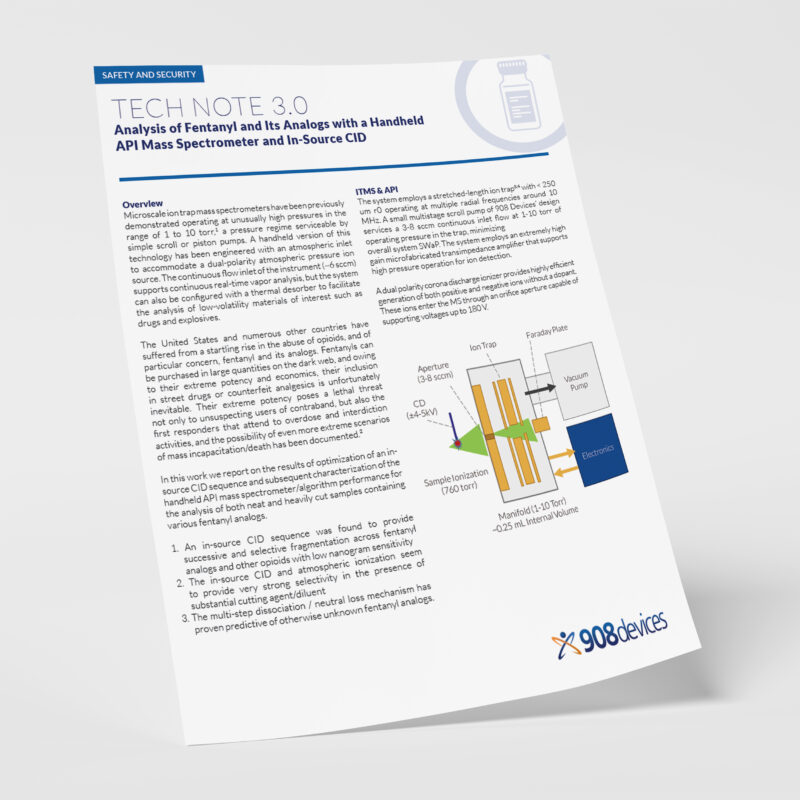
This work explores the use of a handheld mass spectrometer for detecting fentanyl and its analogs, with a focus on optimizing in-source CID (collision-induced dissociation) for high sensitivity and selectivity, even in the presence of cutting agents. The system employs a low-pressure ion trap, dual-polarity corona discharge ionization, and thermal desorption for real-time vapor analysis, enabling detection of low-volatility substances like opioids. The study demonstrates that the system provides nanogram sensitivity, strong selectivity, and the ability to identify unknown fentanyl analogs through predictive fragmentation patterns. Additionally, the system showed superior performance compared to traditional optical methods in the analysis of contaminated fentanyl samples, achieving detection limits in the sub-100 ng range. The algorithm used in the mass spectrometer effectively identifies a wide range of fentanyl analogs based on mass spectral dissociation patterns. Overall, the handheld device proves to be a versatile tool for opioid detection and other applications.
Subscribe to Our Communications
Signup to receive new product updates, technical tips and more.