
Is that bag of green powder an herbal supplement, or something far more dangerous? For officers and responders, kratom (Mitragyna speciosa) is increasingly hard to specify. The leaf is sold openly in smoke shops and gas stations as a natural way to boost energy or unwind, yet the same name now covers concentrated products, one of which may soon join heroin as a Schedule I drug.¹ When suspected kratom turns up during a search, responders need the right technology to identify the suspected drug substances.
What Is Kratom?
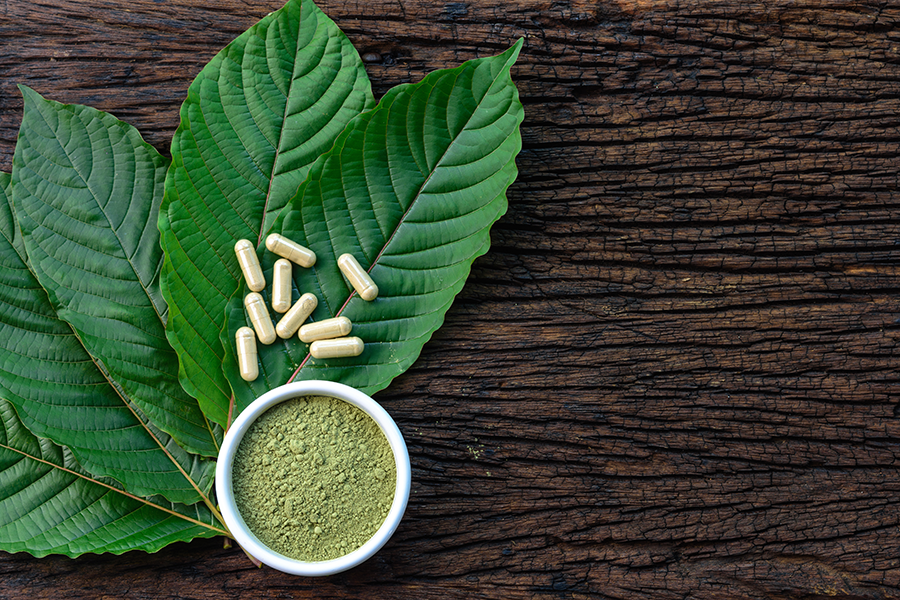
Kratom is a relative of the coffee plant that grows in Southeast Asia, where its leaves have long been chewed or steeped in tea for an energy boost. Because of export laws in major supplying countries such as Indonesia, kratom mostly arrives in the U.S. as ground plant material, sold loose or in capsules, often with bold health claims and no FDA approval to back them up. More than 5 million Americans have tried it, with use highest among adults aged 21 to 34.²
Mitragynine and 7-OH: The Key Compounds
How can kratom both energize and sedate? Kratom’s effects come down to two compounds:
- Mitragynine, the main act. This is the most abundant compound in the leaf, making up about 0.5–2% of its dry weight. At low doses, mitragynine tends to act like a stimulant, but at higher doses it turns sedating and opioid-like.³
- 7-Hydroxymitragynine (7-OH), the powerhouse. This makes up less than 0.02% of the leaf by dry weight, but is far stronger. The human body converts some mitragynine into 7-OH, which is a big reason the leaf has opioid-like effects at all.⁴
Kratom’s strength also varies with where it’s grown, how it’s processed, and what gets blended in, so two products with the same label can be very different.
Concentrated Products and New Regulations
Kratom doesn’t always stay in leaf form. Mitragynine is concentrated into pills, vapes, beverages, and other products, with no federal limits. Since around 2025, concentrated 7-OH has followed in pills and extracts, many made by chemically converting mitragynine, and some 5 to 50 times more potent than regular kratom.² Some products are “enhanced” plant material: kratom or other leaf material sprayed with concentrated 7-OH or other synthetics. The FDA has warned that these products are sold as “natural” when they are semi-synthetic.⁵
Regulators are responding. In August 2026, the DEA temporarily placed three synthetic and semi-synthetic kratom derivatives in Schedule I: mitragynine pseudoindoxyl (MP), MGM-15, and MGM-16.⁶ Because they don’t occur in nature, there’s zero tolerance.
In October 2026, the DEA announced its intent to also place 7-OH, along with MP, in Schedule I above a set threshold: more than 1 milligram per gram (or per milliliter for liquids), or a mitragynine-to-7-OH ratio below 100.¹ The threshold would allow some kratom products to remain on the market, and mitragynine itself would stay unscheduled. States are writing their own rules too. In August 2026, Massachusetts temporarily placed kratom in Schedule I and authorized local officials to remove kratom products from store shelves.⁷
Health Risks of Kratom
Kratom’s “natural” label can be misleading. According to the National Institutes of Health, kratom use has been linked to dependence and withdrawal, liver damage, seizures, and harmful interactions with alcohol and other drugs.⁷ Testing has also found some kratom products contaminated with heavy metals and Salmonella.³
The risks climb even higher with concentrated 7-OH. According to the DEA, poison centers reported 165 exposure cases involving 7-OH from January through July 2025. In more than a third of cases where 7-OH was the only substance involved, the outcome was serious, and even fatal in some instances.¹
Identifying Kratom in the Field
When suspected kratom turns up during a search, the questions start fast. Is it plain leaf, an “enhanced” product, or a concentrated 7-OH pill? Traditional color-change test kits were designed for common illicit drugs, not complex plant blends, and often leave responders without a clear answer.⁸ Because kratom comes in so many forms, the right tool depends on what’s in hand.
| Kratom Form | Identification Tool | What It Does |
|---|---|---|
| Ground leaf and powder | NIRLab | Identifies kratom and quantifies mitragynine |
| Capsules | NIRLab | Open the capsule and scan the plant material inside |
| “Enhanced” plant material | NIRLab, then MX908 + reachback | NIRLab identifies the plant material; suspected 7-OH or synthetics go to MX908 and expert reachback |
| Pills and extracts | MX908 | Detects mitragynine; suspected 7-OH reviewed by reachback |
| Drinks, edibles, and other complex products | MX908 + reachback | Expert support to interpret results |
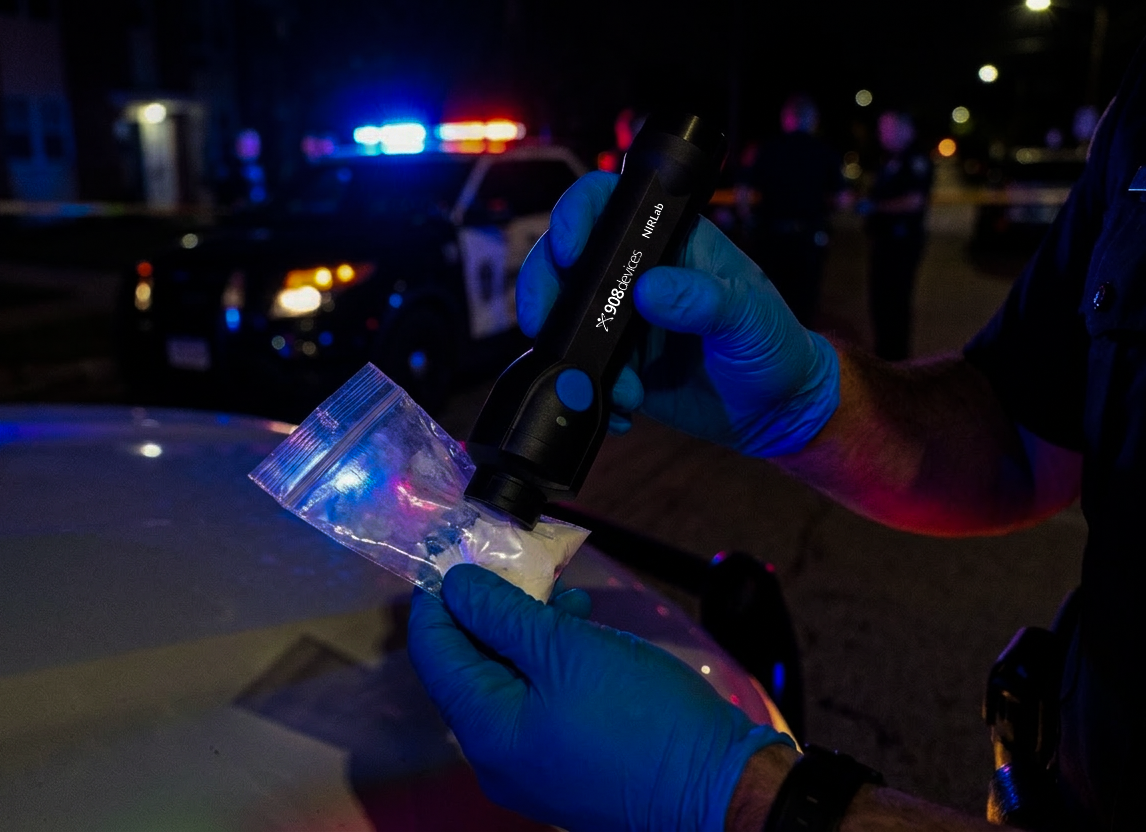
NIRLab is a handheld near-infrared (NIR) narcotics analyzer that uses safe, invisible light to read a plant sample’s chemical fingerprint in seconds, leaving the sample intact. For pills and extracts, where plant material is no longer in the picture, MX908 targets mitragynine. For atypical products, or when results don’t match what’s expected, 908 Devices reachback scientists can help interpret the data. In one recent case, pills labeled “7-OH / Kratom” triggered MX908 alarms for xylazine and suspected fentanyl, alarms that can appear when 7-OH is present. Reachback review confirmed 7-OH in the pills, marking the first 7-OH identifications made through 908 Devices reachback.
Why Identification Matters
Kratom sits in a gray zone: part traditional plant, part emerging drug threat, and increasingly the target of new laws. As concentrated 7-OH products spread, fast and accurate identification is more important than ever. See the identification devices in action. Request a demo to learn how responders identify kratom on site.
References
- U.S. Drug Enforcement Administration. (2026, October 14). Schedules of controlled substances: Temporary placement of 7-hydroxymitragynine and mitragynine pseudoindoxyl above a specified threshold in Schedule I. Notice of intent, FR Doc. 2026-20943.
- University of Michigan Institute for Healthcare Policy and Innovation. (2026). National study finds kratom use is rising.
- National Institute on Drug Abuse. Kratom.
- Kruegel, A. C., et al. (2019). 7-Hydroxymitragynine is an active metabolite of mitragynine and a key mediator of its analgesic effects. ACS Central Science, 5(6), 992–1001.
- U.S. Food and Drug Administration. Hiding in plain sight: 7-OH products.
- U.S. Drug Enforcement Administration. (2026, August 26). Federal Register, 91, 54948.
- Massachusetts Department of Public Health. Kratom.
- National Center for Complementary and Integrative Health. Kratom.
- Evaluation of four field portable devices for the rapid detection of mitragynine in suspected kratom products (2021). Journal of Pharmaceutical and Biomedical Analysis.