
MX908 Helps Resolve Bolivia Mass Poisoning
Discover how the MX908 portable spectrometer rapidly solved a dimethylphosphite poisoning case in Bolivia.
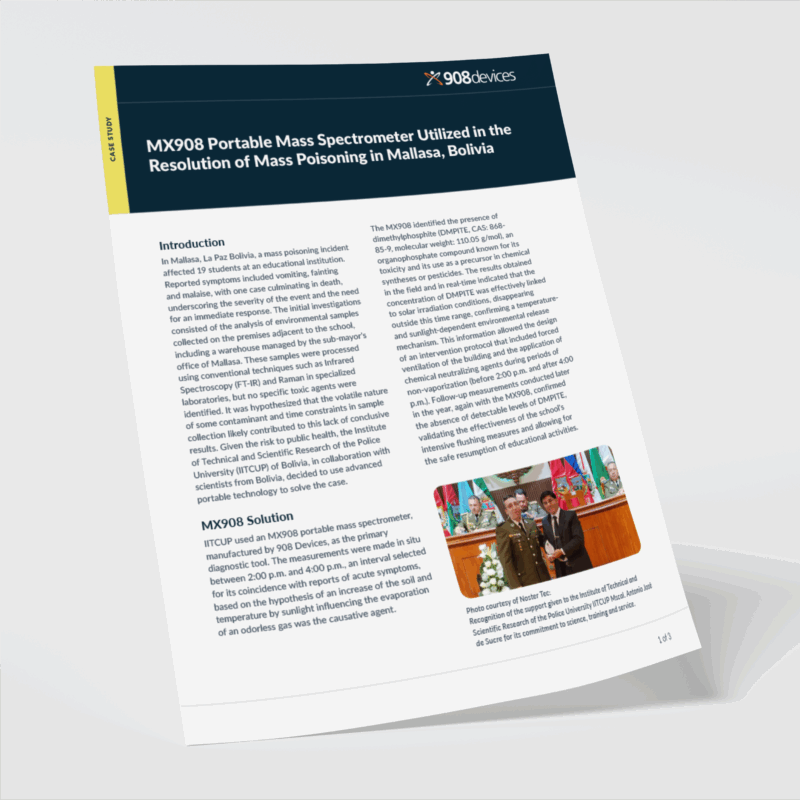
A mass poisoning at a school in Mallasa, Bolivia was traced to dimethylphosphite (DMPITE), a toxic organophosphate released under sunlight and heat. The MX908 portable mass spectrometer enabled rapid on-site detection, guiding effective interventions and proving its value in real-time public health emergencies.
MX908 Portable Mass Spectrometer Utilized in the
Resolution of Mass Poisoning in Mallasa, Bolivia
Introduction
In Mallasa, La Paz Bolivia, a mass poisoning incident affected 19 students at an educational institution. Reported symptoms included vomiting, fainting and malaise, with one case culminating in death, underscoring the severity of the event and the need for an immediate response. The initial investigations consisted of the analysis of environmental samples collected on the premises adjacent to the school, including a warehouse managed by the sub-mayor’s office of Mallasa. These samples were processed using conventional techniques such as Infrared Spectroscopy (FT-IR) and Raman in specialized laboratories, but no specific toxic agents were identified. It was hypothesized that the volatile nature of some contaminant and time constraints in sample collection likely contributed to this lack of conclusive results. Given the risk to public health, the Institute of Technical and Scientific Research of the Police University (IITCUP) of Bolivia, in collaboration with
scientists from Bolivia, decided to use advanced portable technology to solve the case.
MX908 Solution
IITCUP used an MX908 portable mass spectrometer, manufactured by 908 Devices, as the primary diagnostic tool. The measurements were made in situ between 2:00 p.m. and 4:00 p.m., an interval selected for its coincidence with reports of acute symptoms, based on the hypothesis of an increase of the soil and temperature by sunlight influencing the evaporation of an odorless gas was the causative agent.
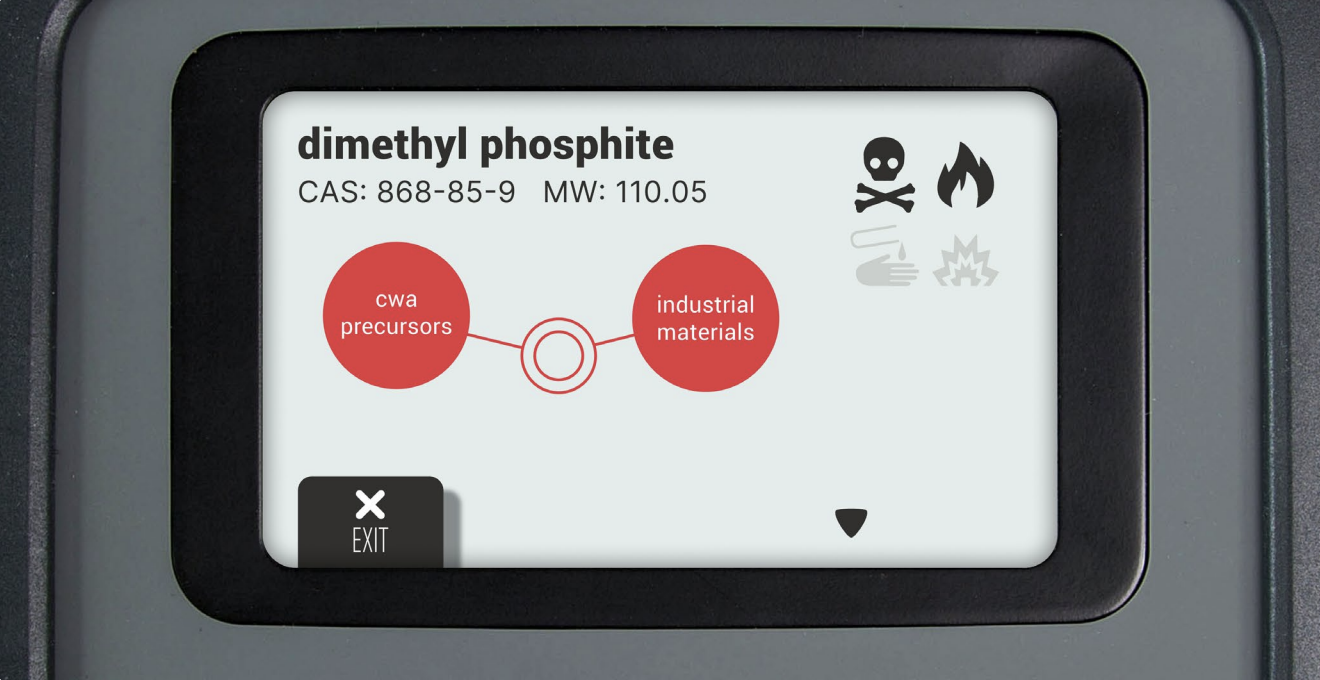
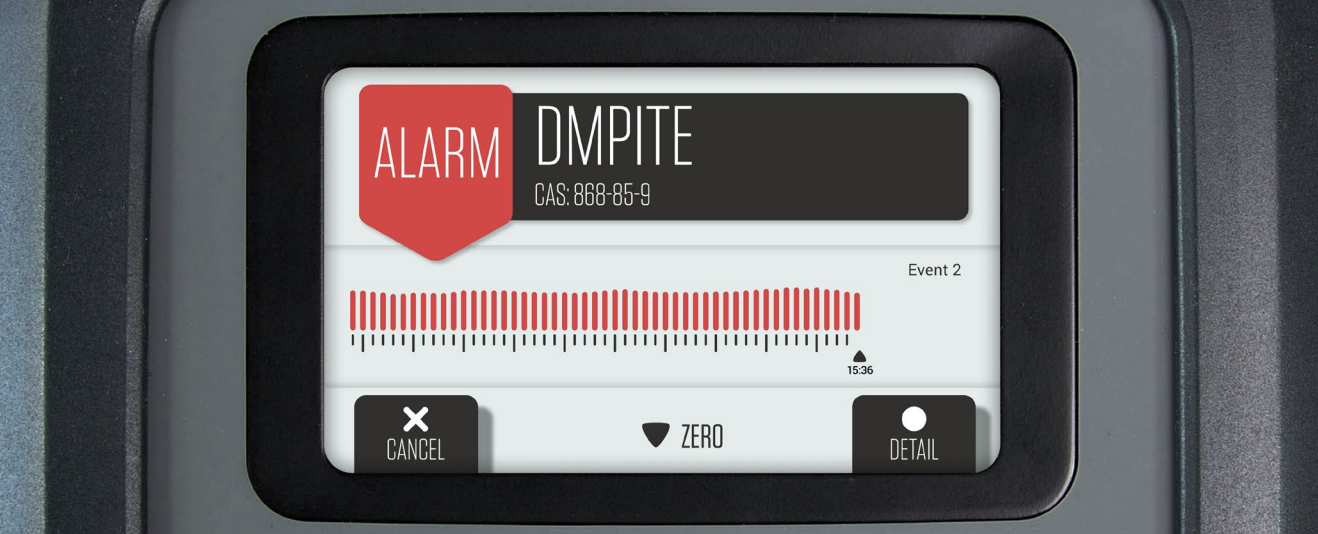
The MX908 identified the presence of dimethylphosphite (DMPITE, CAS: 868-85-9, molecular weight: 110.05 g/mol), an
organophosphate compound known for its toxicity and its use as a precursor in chemical syntheses or pesticides. The results obtained in the field and in real-time indicated that the concentration of DMPITE was effectively linked to solar irradiation conditions, disappearing outside this time range, confirming a temperature- and sunlight-dependent environmental release mechanism. This information allowed the design of an intervention protocol that included forced ventilation of the building and the application of chemical neutralizing agents during periods of non-vaporization (before 2:00 p.m. and after 4:00 p.m.). Follow-up measurements conducted later in the year, again with the MX908, confirmed the absence of detectable levels of DMPITE, validating the effectiveness of the school’s intensive flushing measures and allowing for the safe resumption of educational activities.

Photo courtesy of Noster Tec:
Recognition of the support given to the Institute of Technical and Scientific Research of the Police University IITCUP Mscal. Antonio José de Sucre for its commitment to science, training and service.
MX908 Technical Features
MX908 is a portable mass spectrometer designed for real-time detection and analysis of volatile chemical compounds and threat agents, such as narcotics, explosives, chemical warfare agents, and toxic industrial substances. Its core technology, high-pressure mass spectrometry (HPMS), represents a significant advance in the miniaturization and portability of chemical analysis systems, allowing its use in field scenarios with high sensitivity and selectivity. HPMS is a variant of mass spectrometry that operates at significantly higher pressures than traditional systems, which require high vacuum conditions. In contrast, the HPMS can operate at pressures of approximately 1 Torr or more, which
drastically reduces vacuum needs and allows the use of miniaturized components. These factors enable MX908 to provide high fidelity chemical identification at the point of need with little training, versus waiting hours or even days for laboratory results.
Practical Applications
The MX908 is used by first responders, military forces, and law enforcement agencies in a variety of situations.
- Narcotics Identification: Identifies illicit drugs and precursors, supporting organized crime investigations.
- Explosives Identification: Analyzes explosive materials and their components, crucial for public safety.
- Chemical Agent Identification: Identifies chemical warfare agents and toxic industrial substances, such as in HazMat incident responses.
- Environmental monitoring: Evaluates chemical pollutants in the air or surfaces, protecting communities.
Advantages Over Traditional Technologies
Compared to laboratory mass spectrometers, the MX908 offers:
- Portability: Its compact design makes it usable in the field, unlike laboratory systems that require fixed installations.
- Speed: Provides results in minutes, whereas traditional tests can take days or weeks.
- Use in complex environments: Its ability to operate in the presence of environmental interferers makes it ideal for real-world situations, such as industrial or emergency areas.
Contribution of Technology to Complex Problems
The MX908 overcomes the limitations of traditional methods by providing results in minutes, in contrast to the days or weeks required by centralized lab tests. This speed is critical in public health emergencies, where delay can increase risks. In addition, its high priority, threat target list facilitates the identification of unconventional agents, such as DMPITE.
The technology also supports forensic applications by enabling traceability of contaminants in time and space, which was key to correlating DMPITE levels with environmental conditions in Mallasa.
Conclusion
The MX908 is a revolutionary tool for real-time chemical analysis, with critical applications in public safety and emergency response. Its combination of portability, sensitivity, and selectivity positions
it as a standard in chemical threat identification, demonstrating its value even in high altitude cases such as Mallasa which sits at 11,975ft (3,650m) above sea level.
The MX908 portable mass spectrometer was instrumental in solving the mass poisoning crisis at Mallasa, offering real-time detection and accurate situational analysis. Its ability to operate
in dynamic environments and its sensitivity to trace concentrations make it an essential tool for the management of complex chemical emergencies. The results not only mitigated the immediate risk, but also set a precedent for the use of portable
technologies in protecting public health and environmental safety.
Subscribe to Our Communications
Signup to receive new product updates, technical tips and more.