
XplorIR Case Study – Urban Hazmat Incident
Hazmat responders used XplorIR to rapidly identify tetrachloroethylene during an urban incident, enabling faster, safer chemical response.
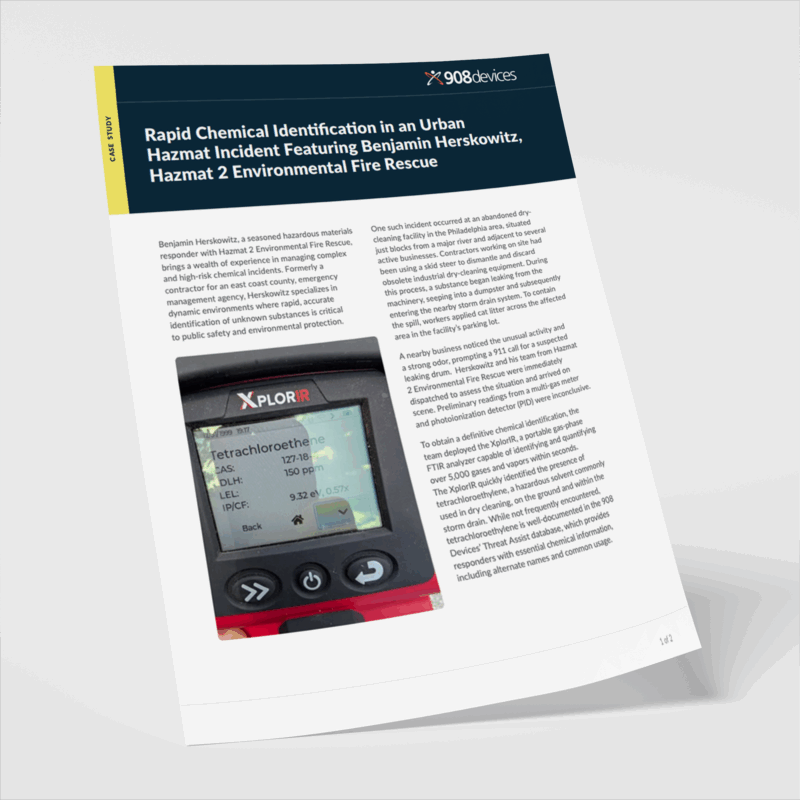
At an abandoned dry-cleaning facility in Philadelphia, a chemical spill occurred during equipment removal, releasing an unknown substance into the storm drain near businesses and a major river. Hazmat responder Benjamin Herskowitz and his team from Hazmat 2 Environmental Fire Rescue were dispatched after reports of a strong odor. Initial readings were inconclusive, but using the XplorIR portable FTIR analyzer, the team quickly identified the chemical as tetrachloroethylene, a hazardous dry-cleaning solvent.
Rapid Chemical Identification in an Urban Hazmat Incident Featuring Benjamin Herskowitz,
Hazmat 2 Environmental Fire Rescue
Benjamin Herskowitz, a seasoned hazardous materials responder with Hazmat 2 Environmental Fire Rescue, brings a wealth of experience in managing complex and high-risk chemical incidents. Formerly a contractor for an east coast county, emergency management agency, Herskowitz specializes in dynamic environments where rapid, accurate identification of unknown substances is critical to public safety and environmental protection.
One such incident occurred at an abandoned drycleaning facility in the Philadelphia area, situated just blocks from a major river and adjacent to several active businesses. Contractors working on site had been using a skid steer to dismantle and discard obsolete industrial dry-cleaning equipment. During this process, a substance began leaking from the machinery, seeping into a dumpster and subsequently entering the nearby storm drain system. To contain the spill, workers applied cat litter across the affected area in the facility’s parking lot.
A nearby business noticed the unusual activity and a strong odor, prompting a 911 call for a suspected leaking drum. Herskowitz and his team from Hazmat 2 Environmental Fire Rescue were immediately dispatched to assess the situation and arrived on scene. Preliminary readings from a multi-gas meter and photoionization detector (PID) were inconclusive.
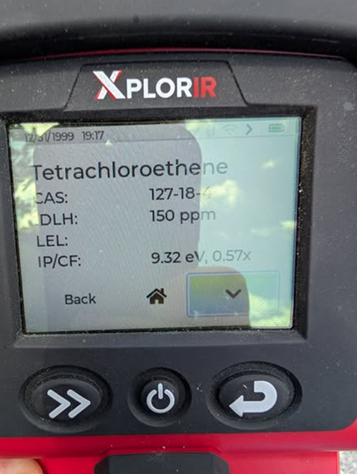
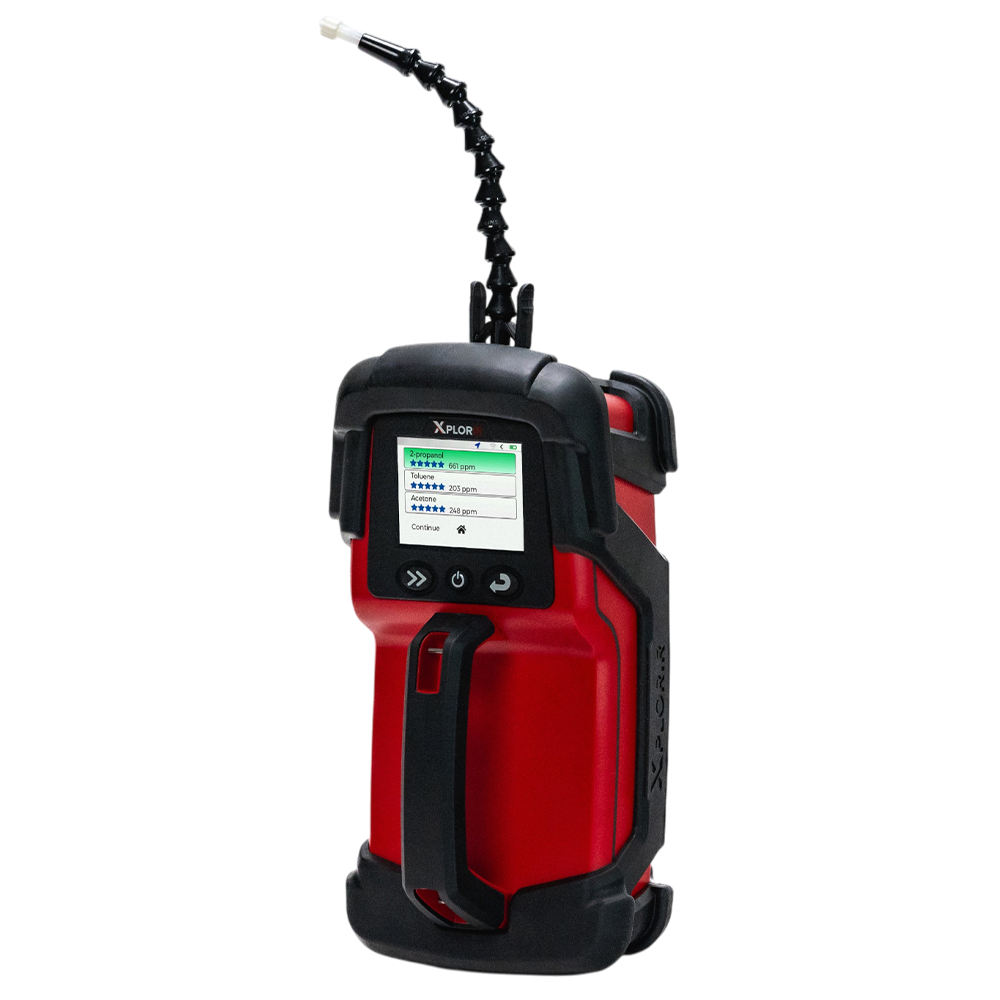
To obtain a definitive chemical identification, the team deployed the XplorIR, a portable gas-phase FTIR analyzer capable of identifying and quantifying over 5,000 gases and vapors within seconds. The XplorIR quickly identified the presence of tetrachloroethylene, a hazardous solvent commonly used in dry cleaning, on the ground and within the storm drain. While not frequently encountered, tetrachloroethylene is well-documented in the 908 Devices’ Threat Assist database, which provides responders with essential chemical information, including alternate names and common usage.
The Threat Assist Database would quickly provide responders with the knowledge that tetrachloroethylene is “a clear colorless volatile liquid having an ether-like odor” and that it is “used as a dry cleaning solvent.”
Using a telepresence unit, the team conducted additional research to better understand the chemical’s properties and potential reactions. They confirmed that tetrachloroethylene could form hazardous acidic vapors when in contact with water or ammonia, both of which were possibly present at the site. A thorough sweep of the premises was conducted to rule out additional threats. During the search, responders located a drum inside the building labeled as containing tetrachloroethylene, further corroborating the XplorIR results.
The situation was complicated by an individual onsite exhibiting symptoms including lightheadedness and headache. Thanks to the real-time identification capabilities of the XplorIR and the team’s rapid assessment, EMS personnel were promptly informed of the tetrachloroethylene exposure, allowing for immediate and appropriate medical treatment.
Reflecting on the incident, Herskowitz emphasized the crucial role of advanced technology in modern hazmat response:
“There is an impossible number of combinations when it comes to chemicals and their interactions. XplorIR gives us the truth quickly, so we can make the right decision faster, with less risk.”
Without the XplorIR, responders would have relied on visual labeling alone or conducted time consuming wet chemistry analysis using hazcat kits- methods that introduce uncertainty and delay. Instead, the team was able to act based on verified data, integrating physical evidence, eyewitness accounts, and advanced identification tools.
Thanks to this swift and informed response, the chemical release was contained before reaching the nearby river, the affected individual received timely medical care, and remediation began immediately with confidence and clarity.
Subscribe to Our Communications
Signup to receive new product updates, technical tips and more.