Rapid Chemical Spill Identification with ProtectIR FTIR
ProtectIR enables rapid chemical spill identification, helping responders contain nitric acid safely and prevent environmental harm in Ukraine.
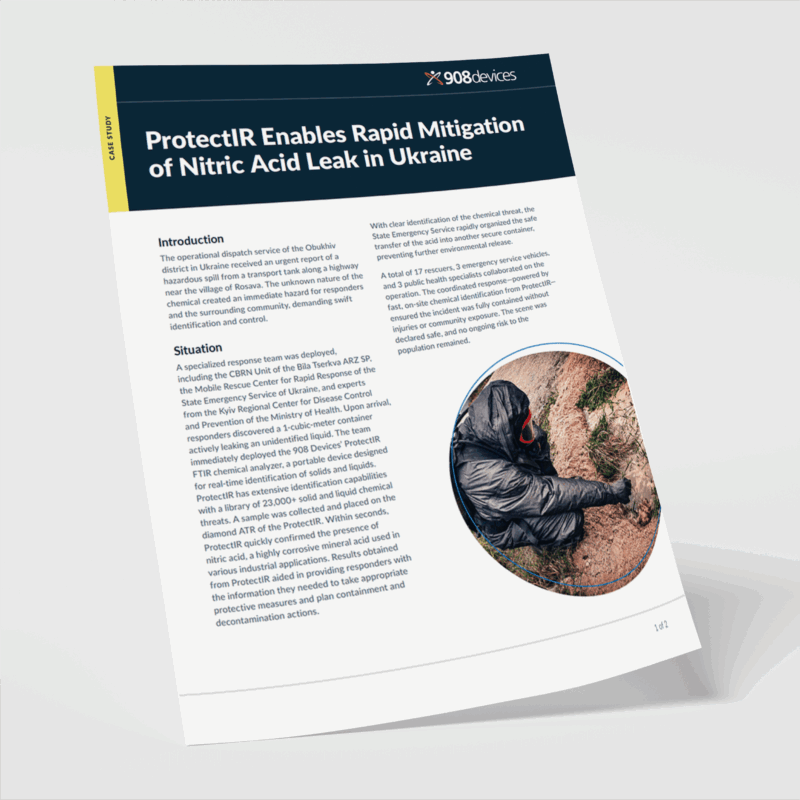
An urgent hazardous spill occurred near Rosava village in Ukraine, involving an unknown chemical leaking from a 1-cubic-meter container. A specialized response team—including the CBRN Unit, Mobile Rescue Center, and public health experts—was deployed. Using the ProtectIR FTIR chemical analyzer from 908 Devices, responders quickly identified the substance as nitric acid, a highly corrosive industrial chemical.
ProtectIR Enables Rapid Mitigation of Nitric Acid Leak in Ukraine
Introduction
The operational dispatch service of the Obukhiv district in Ukraine received an urgent report of a hazardous spill from a transport tank along a highway near the village of Rosava. The unknown nature of the chemical created an immediate hazard for responders and the surrounding community, demanding swift identification and control.
Situation
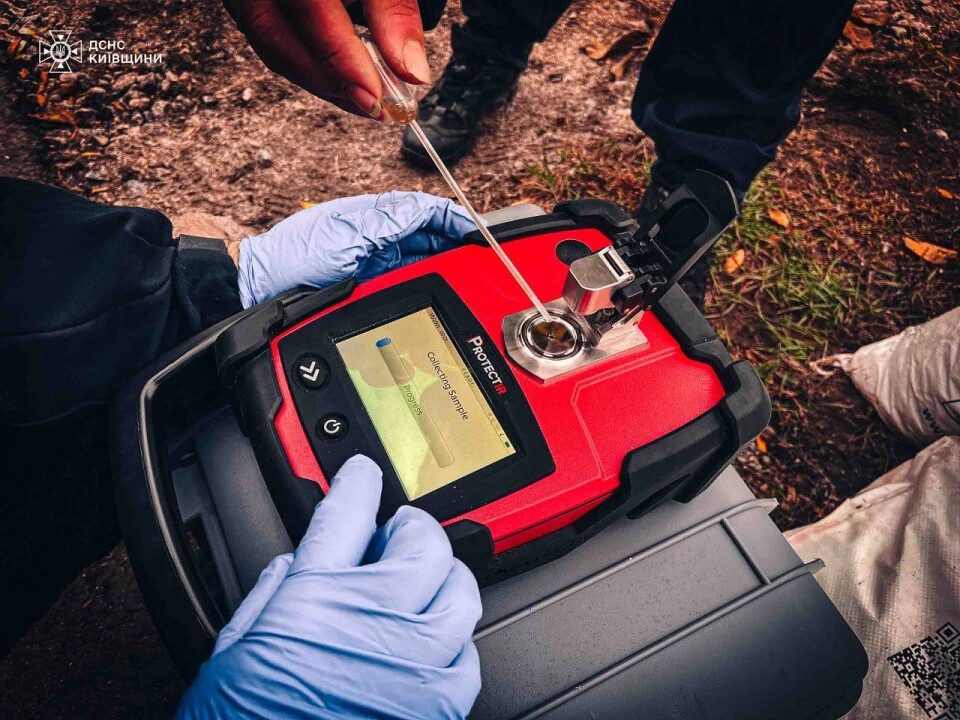
A specialized response team was deployed, including the CBRN Unit of the Bila Tserkva ARZ SP, the Mobile Rescue Center for Rapid Response of the State Emergency Service of Ukraine, and experts from the Kyiv Regional Center for Disease Control and Prevention of the Ministry of Health. Upon arrival, responders discovered a 1-cubic-meter container actively leaking an unidentified liquid. The team immediately deployed the 908 Devices’ ProtectIR FTIR chemical analyzer, a portable device designed for real-time identification of solids and liquids. ProtectIR has extensive identification capabilities with a library of 23,000+ solid and liquid chemical threats. A sample was collected and placed on the diamond ATR of the ProtectIR. Within seconds, ProtectIR quickly confirmed the presence of nitric acid, a highly corrosive mineral acid used in various industrial applications. Results obtained from ProtectIR aided in providing responders with the information they needed to take appropriate protective measures and plan containment and decontamination actions.
With clear identification of the chemical threat, the State Emergency Service rapidly organized the safe transfer of the acid into another secure container, preventing further environmental release.
A total of 17 rescuers, 3 emergency service vehicles, and 3 public health specialists collaborated on the operation. The coordinated response—powered by fast, on-site chemical identification from ProtectIR— ensured the incident was fully contained without injuries or community exposure. The scene was declared safe, and no ongoing risk to the population remained.

Conclusion
This incident highlights how ProtectIR delivers critical situational awareness during chemical emergencies, allowing responders to confirm hazardous solids and liquids to mitigate response. By enabling confident, immediate decisions in the field, ProtectIR supports safer, faster, and more effective incident resolution, protecting both responders and the public. Beyond this single event, it also reflects a broader regional shift across Eastern Europe, where the transportation of hazardous materials by road is increasing as rail, pipeline, and cross-border logistics face constraints from conflict, sanctions, and infrastructure gaps. As more dangerous goods move through mixed-use corridors and industrial zones, frontline responders are becoming the first line of defense against evolving chemical risks. In this context, rapid fieldbased identification tools like ProtectIR are essential, not only for emergency containment but also for sustaining operational confidence and safety in a landscape where hazardous transport routes are being redefined in real time.
Subscribe to Our Communications
Signup to receive new product updates, technical tips and more.