The next synthetic opioid doesn’t arrive as “the next synthetic opioid.” It arrives as an unknown powder, a counterfeit pill, a jail seizure, or an overdose scene that doesn’t fit the usual script, and it shows up before most dashboards, statutes, and routine screening methods can clearly name it. That’s the adaptive cycle we’ve lived through with fentanyl. It repeated with nitazenes. And now it’s playing out again with orphines (benzimidazol-2-one opioids).
Tennessee is what the early warning looks like
A recent Tennessee news report1 highlights exactly why emerging synthetics are an operational problem, not just a chemistry problem. In East Tennessee, N-propionitrile chlorphine (“cychlorphine”), an orphine analogue, has been linked to 19 overdose death investigations, and the reporting underscores limits in both detection and legal/reporting clarity as novel compounds enter the market faster than systems can adapt.
From Drug Enforcement to WMD-Level Threat
What makes this case especially instructive for public safety leaders:
- The Knox County Regional Forensic Center reported 19 deaths under investigation (with confirmed and pending cases).
- The Tennessee Bureau of Investigation crime lab reported multiple seized drug submissions positive for cychlorphine across 2025 and early 2026 meaning this isn’t only a post-incident toxicology issue; it’s showing up in enforcement encounters.
- National early-warning organizations have flagged cychlorphine as an emergent orphine and documented that these opioids often appear in complex mixtures with other opioids and substances, increasing both overdose risk and interpretation complexity.
The takeaway: the risk window is the gap between first appearance and broad recognition when frontline teams are making high-stakes decisions with incomplete certainty.

The operational issue: “negative” doesn’t always mean “low risk”
Orphines are structurally different from fentanyl-class compounds. That matters because many workflows, both in the field and in toxicology, are optimized for what is already known and commonly encountered.
When newly engineered opioids emerge, a dangerous dynamic can occur: the compound is present and causing harm, but routine detection and reporting often lag behind.
Tennessee’s cychlorphine signal is a real-world example of why readiness can’t rely on a single presumptive screen or a single data category in a public dashboard.
Field intelligence is how agencies stay ahead of the curve
Field intelligence is not a buzzword. It’s a practical capability, turning an “unknown” into actionable information fast enough to change decisions; on PPE posture, evidence handling, scene safety, investigative direction, and partner notification.
That’s increasingly the difference between:
- treating every unknown as the same problem, and
- recognizing when the market has shifted underneath you.
MX908 + Reachback: closing the time-to-clarity gap
As synthetic opioids diversify, agencies need tools and support designed for adaptation, not a static list of known threats.
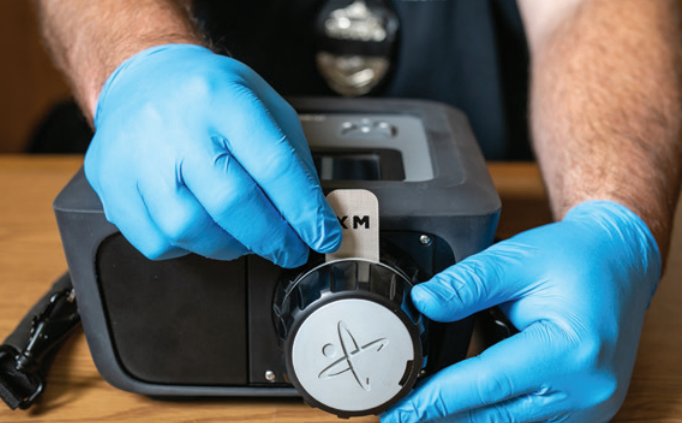
MX908 is built to help teams analyze unknown substances closer to the point of encounter, supporting faster, more defensible decisions when uncertainty is high.
And when new compounds appear, as they do in the adaptive cycle, 908 Devices Reachback extends that capability with expert support to help interpret unusual findings, validate results in complex mixtures, and accelerate operational understanding.
Because in the real world, emerging threats don’t wait for the system to catch up.
What agencies should do now
If your teams are seeing more “unknowns” in powders, pills, jail contraband, or interdiction environments, now is the time to tighten the system:
- Re-brief teams that new opioid classes are emerging beyond fentanyl and nitazenes.
- Reinforce that presumptive screens are inputs, not final answers, especially with evolving synthetics.
- Strengthen your pathway from field encounter to lab coordination to intelligence sharing, so the next “unknown” becomes a faster warning signal, not a delayed surprise.