Why Classification Matters and How MX908 Supports the Mission
Federal narcotics interdiction has always been about stopping drugs before they reach communities. But the rise of fentanyl has fundamentally changed the mission, elevating interdiction from a drug enforcement function to a national security priority.
On December 15, 2025, Executive Order 14367 designated illicit fentanyl and certain core precursor chemicals as Weapons of Mass Destruction (WMD) 1, directing federal agencies to apply and align counter-WMD and national security authorities against fentanyl trafficking networks. This posture shift has significant implications for interdiction strategy, responder safety, and frontline technology.
From Drug Enforcement to WMD-Level Threat
Traditional narcotics interdiction focused on volume: large shipments, trafficking routes, and organized networks. Fentanyl has upended that model.
- As little as ~2mg can be fatal2
- Potency and composition vary across a rapidly evolving set of fentanyl analogues
- Low detection thresholds allow drugs to be concealed in mail, packaging, paper, etc.
- Operational risk rises when powders are disturbed, creating aerosolization
Consistent with EO 14367’s designation, federal policy is increasingly treating illicit fentanyl, especially when tied to trafficking networks and precursor supply chains, as a national security problem in addition to a criminal enforcement problem. The designation reflects the reality that fentanyl can produce mass casualties without an explosive device, is readily accessible for delivery systems, is easily sourced in large quantities, and can be deployed with no warning.

What This Means for Federal Interdiction Operations
This evolution changes how interdiction is executed. In practice, teams operate on the assumption that bulk substances and trafficked materials can leave trace residues, often invisible, yet still meaningful for safety and enforcement decisions. This means that in high-risk environments, rapid identification at first contact can be as mission critical as the seizure itself, because it drives safety and immediate operational decisions.
- Safety: knowing early changes decisions in PPE, handling, ventilation, and whether to open/move an item.
- Decision speed: it drives immediate next steps (isolate, hazmat, detain/release, escalate).
- Prevention vs. tally: preventing exposure or a bad decision can be more mission-critical than maximizing the amount physically seized in that moment.
- Chain-of-custody discipline: early ID supports proper packaging, documentation, and lab prioritization.
Mail facilities, ports of entry, border crossings, correctional facilities, and transportation hubs have become high-risk environments where inadvertent contact can drive serious operational and safety decisions. This is especially true if the powders are disturbed or aerosolized, so protocols emphasize minimizing handling and preventing airborne exposure.
The Technology Gap in the Field
Many field identification technologies perform well on bulk materials but can be challenged by trace residues or low-percentage mixtures, conditions that are common in the context of interdiction (outer packaging, cross contamination, complex cutting agents). Federal, state, and local interdiction teams increasingly need actionable chemical intelligence in real time, without prolonged handling of unknown substances, to support safe and defensible decisions.
How MX908 Supports Modern Interdiction Missions
The MX908 was built for this environment. This powerful tool supports rapid, presumptive field identification in interdiction environments where speed, trace sensitivity, and safety matter.
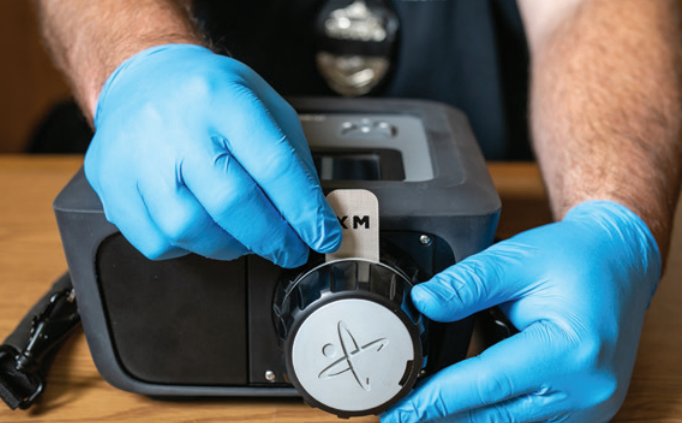
Using high-pressure mass spectrometry (HPMS), MX908 supports rapid, presumptive identification of fentanyl and other priority drugs from trace residues collected by swab, often in under a minute, helping teams make faster safety and operational decisions while limiting unnecessary handling. Capabilities include:
- Supporting rapid presumptive identification of fentanyl and priority drugs
- Identify trace residues on the exterior of packaging, mail, and surfaces.
- Enabling informed decisions in minutes rather than waiting for days.
Field results can inform immediate safety actions and investigative priorities, while confirmatory lab testing and local evidentiary requirements still apply. In WMD-adjacent operating conditions, this helps reduce uncertainty, limits unnecessary exposure, and supports safe operational outcomes.
Supporting the Shift Toward Prevention
Federal narcotics interdiction is no longer just about enforcement after the fact. It’s about preventing harm before it occurs—to communities and the professionals tasked with protecting them.
As fentanyl continues to reshape the threat landscape, technologies that deliver rapid, accurate chemical identification at the point of contact are becoming essential—not optional. MX908 helps federal agencies meet this moment with confidence, speed, and safety.