
New survey of 1000 US adults reveals a striking gap between confidence and verification, alongside broad support for faster substance identification by first responders and public health agencies.
Most people who use recreational drugs believe they know what they are consuming. But how many actually verify what’s in those substances? This question is becoming increasingly important as the illicit drug supply grows increasingly complex. Fentanyl remains a major concern, but the emergence of powerful synthetic opioids, veterinary sedatives, and other adulterants has introduced new risks that are not always apparent to the people who consume these substances. What someone believes they purchased may not be what they actually have.
To better understand this gap, 908 Devices surveyed 1,000 U.S. adults who reported using recreational drugs in the past year. The results reveal a striking disconnect: 77% feel confident they know what’s in the substance they use, yet only 23% always verify it.
The findings also reveal broader expectations for public safety. Nearly nine in 10 (87%) believe first responders need better tools to identify unknown substances quickly. Meanwhile, respondents express nearly the same level of trust in labels on state-regulated cannabis products (79%) as they do in prescription labels from pharmacies (80%), highlighting the importance consumers place on reliable information about what they are consuming. When something goes wrong, first responders are often the ones left to identify what a person actually took.
Together, these findings point to a fundamental challenge: confidence is not the same as knowing. And when substances cannot be reliably identified, the consequences extend beyond individual consumers to the law enforcement officers, the first responders, and the public health professionals for responding to an increasingly unpredictable drug supply.
Key Takeaways
- 87% say first responders need better tools to identify unknown substances quickly, and 80% support rapid drug-checking at public health sites. Yet just 7% have ever used a fentanyl or drug-checking test strip.
- 62% of people who use recreational drugs have never heard of nitazenes, and 52% have never heard of medetomidine, two substances increasingly found in the illicit supply.
- 77% are confident they know what’s in the substances they use, but only 23% always verify ingredients, potency, or source before use.
- 24% consult a lab report or Certificate of Analysis before deciding a substance is safe, and the same share (24%) ask an AI chatbot. Gen Z relies on chatbots more than twice as often as Gen X (35% vs. 16%).
- Respondents trust labels on dispensary cannabis (79%) almost exactly as much as labels on prescription drugs from a licensed pharmacy (80%).
- 76% would trust a product more if it carried a scannable, verified lab report, and 81% want more information about what’s in the products they consume.
What Americans Don’t Know Can Still Kill Them
Fentanyl has dominated overdose coverage for most of a decade, and the people who use recreational drugs have absorbed that message. Other substances have drawn a fraction of the attention. Nitazenes, a class of synthetic opioids, and medetomidine, a sedative developed for veterinary use, have both turned up in the illicit supply with growing frequency.
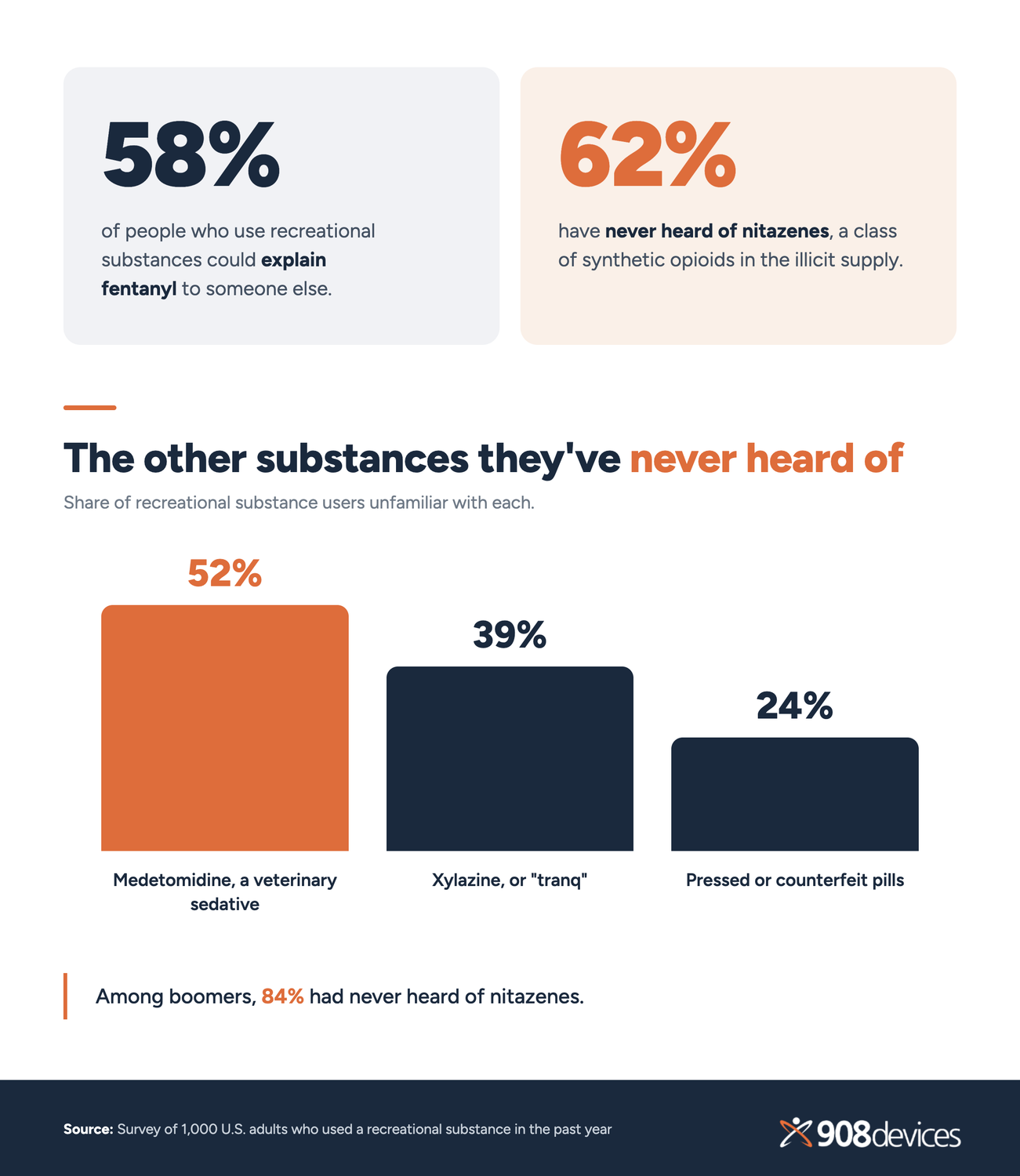
Fentanyl was the substance respondents knew best, with 58% saying they could explain it to someone else and another 37% saying they had heard of it. Synthetic cannabinoids and THC substitutes came close behind, with 53% able to explain them. Pressed pills, the counterfeit prescription tablets the DEA warns about, split the group, with 33% knowing what they were, 42% having heard of them and 24% unfamiliar.
Respondents grew far less certain once the list moved past fentanyl. Most (62%) had never heard of nitazenes, and 52% had never heard of medetomidine. Xylazine, sold on the street as “tranq,” was unfamiliar to 39% despite years of national coverage. That gap carries real consequences, because naloxone does not reverse xylazine’s sedative effects.
Younger respondents knew the newer threats better, a pattern that may reflect years of DEA and school-based prevention campaigns aimed at their age group. Gen Z led on synthetic cannabinoids (60% familiar) and medetomidine (21%, against 15% overall), while 24% of millennials knew about xylazine, compared with 19% of all respondents. Older users sat at the other end. Among boomers, 84% had never heard of nitazenes and 75% had never heard of medetomidine; among Gen X, those shares were 75% and 62%.
Gut Feelings, Google, and GPTs: How Users Confirm What’s Safe
Drug dealers and the cartels that supply them don’t test their product for anyone’s safety, and the people who buy from them know it. Many still feel sure about what they’re taking. Even in legal markets, the testing behind a label varies widely from one product category to the next, so the question of what a buyer can actually rely on reaches well past the street.
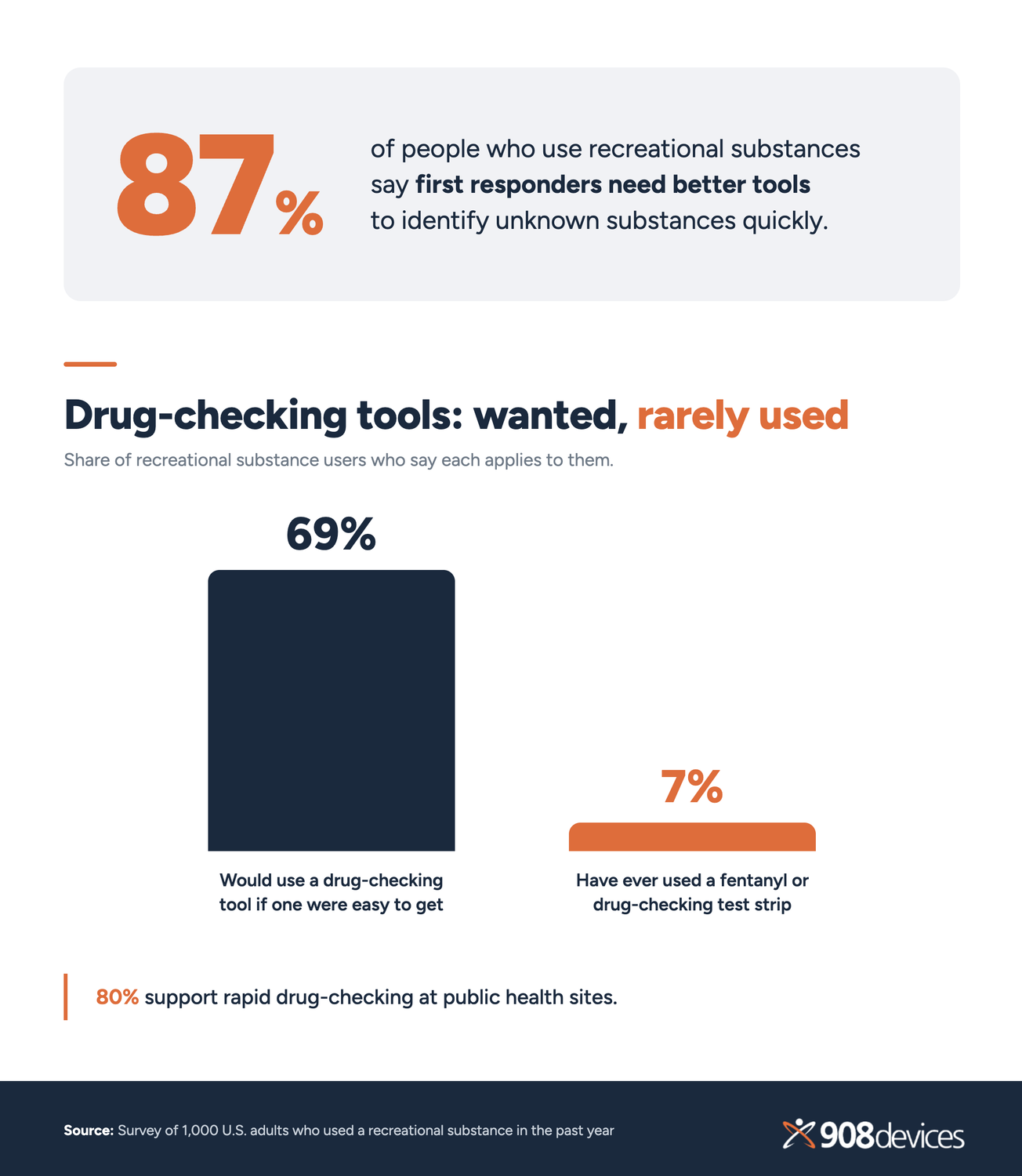
Respondents were overwhelmingly confident, with 77% saying they know what’s in the substances they use, including 34% who are very confident. Their habits told a different story. Only 23% always confirm ingredients, potency, or source before use, and 16% never check at all.
Most respondents (65%) lean on packaging, labels, or branding to judge safety, and 43% go by what the seller tells them. Lab reports or Certificates of Analysis, the only source on the list that documents what a product actually contains, rank near the bottom at 24%. AI chatbots tied them. Gen Z respondents turn to chatbots more than twice as often as Gen X (35% vs. 16%), and men do so more often than women (29% vs. 20%).
Respondents’ heavy reliance on labels would carry less risk if their trust tracked how closely each product is regulated. Most (73%) agree that “legal” or “branded” doesn’t necessarily mean safe. Yet they trust labels on dispensary cannabis (79%) nearly as much as labels on prescription drugs from a licensed pharmacy (80%), even though state-legal cannabis never passes through the FDA approval process that prescription drugs do. Respondents reserved their skepticism for nootropics and “natural” enhancement products, trusting those labels at 40%, the lowest of any category tested. People who lean on a label or a chatbot’s answer come away feeling informed without learning anything verified about the substance in hand.
The Safety Tools Consumers Want but Rarely Reach For
Fentanyl test strips are easier to find than they were a few years ago, though a strip detects only what it was designed to detect and can miss low concentrations. People who use drugs want better tools to exist. Whether they reach for one before using is a separate question.
Respondents have reason to want better tools, and most of them know it. A majority (70%) are extremely or very concerned that a pill bought outside a licensed pharmacy could contain fentanyl, and 25% admit they’ve taken a substance without fully knowing where it came from. Another 39% know someone who has, and 68% worry more about contamination than they did five years ago.
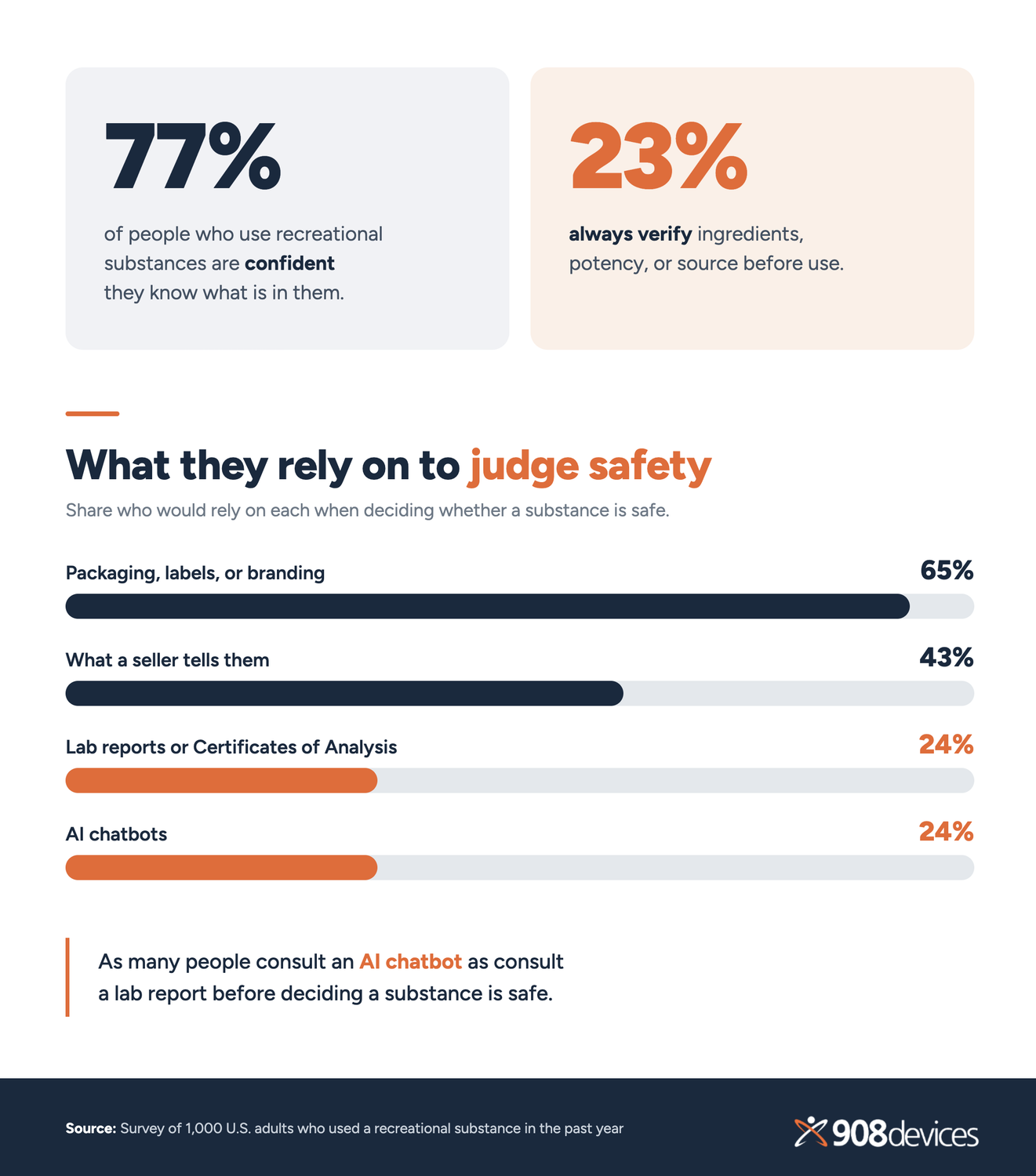
Respondents backed testing at nearly every level, with 87% saying first responders need better tools to identify unknown substances quickly. Most also support rapid drug-checking at public health sites (80%) and at festivals, clubs, and large events (76%), and the same share (76%) say real-time testing in their community would make them feel safer. Outside the U.S., festival drug-checking is already in practice: Belgium’s Tomorrowland festival has an on-site drug lab, and Australia’s New South Wales is resuming pill testing at music festivals.
Respondents’ own habits lag far behind. While 69% say they would use a drug-checking tool if one were easy to get, only 7% have ever used a fentanyl or drug-checking test strip, and just 4% keep naloxone on hand. What they ask for instead is proof attached to the product. Three in four (76%) would trust a product more if it carried a scannable, verified lab report, including 39% who strongly agree, and 81% want more information about what’s in the products they consume.
Closing the Gap Between Feeling Safe and Being Safe
People who use recreational drugs are more confident about what they take than informed about it. They know fentanyl by name but not the sedatives and synthetic opioids arriving alongside it, and the checks they rely on most, a familiar label or a chatbot’s answer, can’t confirm what a substance contains.
The respondents themselves point toward the fix. What they ask for is verification, whether it sits in a first responder’s kit or at the sites where people actually use. Public health messaging needed more than a decade to make fentanyl a household word, and the people buying today’s supply may not have that long.
Methodology
908 Devices surveyed 1,000 U.S. adults who had personally used at least one of the following in the past 12 months: nicotine vapes or e-cigarettes, over-the-counter supplements or nootropics, cannabis or THC products, a prescription medication not prescribed to them, or recreational or party drugs. Questions covered awareness of emerging contaminants, confidence in and verification of what respondents consume, trust in product labels across regulated and lightly regulated categories, and attitudes toward drug-checking tools and regulation. Results were analyzed by generation and gender and are post-stratified where available. All data is self-reported. Percentages may total more than 100% on questions that allowed multiple answers, and may not total exactly 100% on single-answer questions because of rounding.
About 908 Devices
908 Devices is revolutionizing chemical analysis with its simple handheld devices, addressing life-altering applications. The Company’s devices are used at the point-of-need to identify unknown and invisible materials and provide quick, actionable answers in vital health, safety and defense tech applications, addressing the fentanyl and illicit drug crisis, toxic carcinogen exposure, and global security threats.
Fair Use Statement
The findings in this article may be used for non-commercial purposes only. If you share this data or reference these findings, please attribute 908 Devices and link back to this page as the source of the research.