
Leveraging MX908 in Overdose Investigations
The MX908 provides rapid, on-site chemical identification that enhances safety and accelerates evidence gathering during overdose investigations.
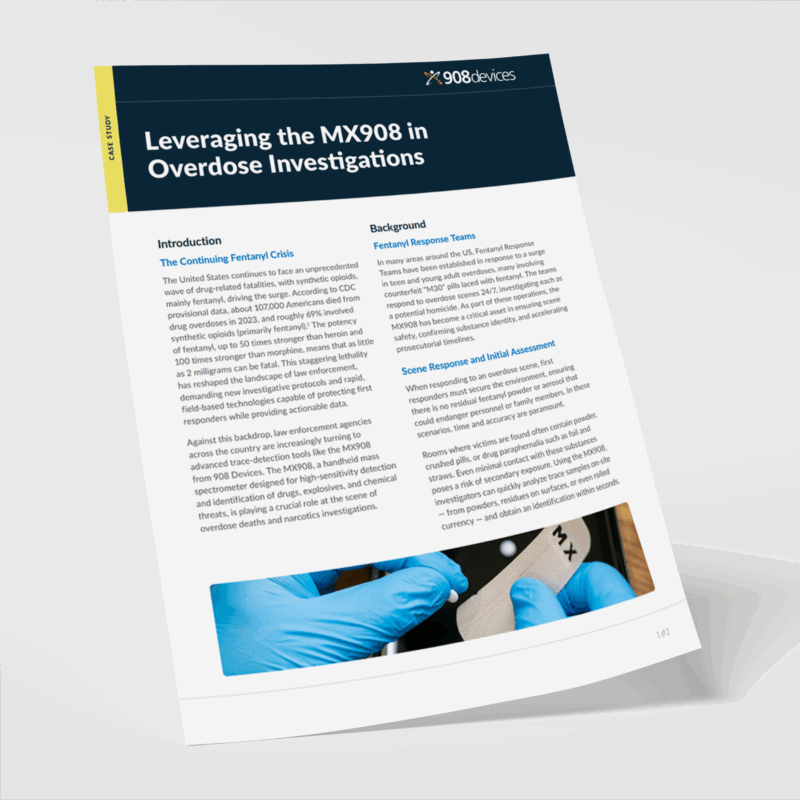
Law enforcement teams are using the MX908 handheld mass spectrometer to quickly identify fentanyl and its analogs at overdose scenes, improving safety and speeding investigations. This rapid, on-site analysis protects responders, preserves evidence, and turns critical data into actionable intelligence against the fentanyl crisis.
Leveraging MX908 in Overdose Investigations
Introduction
The Continuing Fentanyl Crisis
The United States continues to face an unprecedented wave of drug-related fatalities, with synthetic opioids, mainly fentanyl, driving the surge. According to CDC provisional data, about 107,000 Americans died from drug overdoses in 2023, and roughly 69% involved synthetic opioids (primarily fentanyl).1 The potency of fentanyl, up to 50 times stronger than heroin and100 times stronger than morphine, means that as little as 2 milligrams can be fatal. This staggering lethality has reshaped the landscape of law enforcement, demanding new investigative protocols and rapid, field-based technologies capable of protecting first responders while providing actionable data.
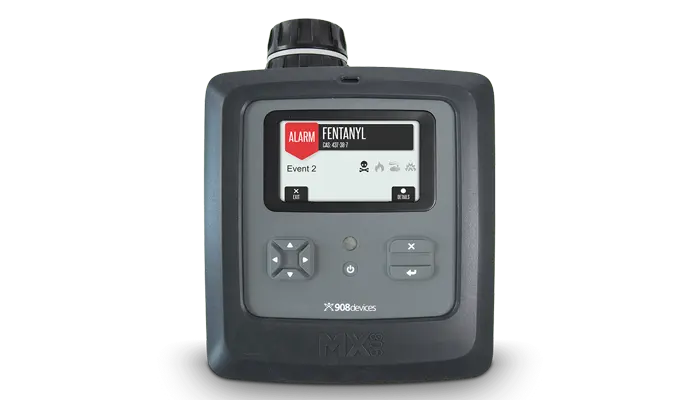
Against this backdrop, law enforcement agencies across the country are increasingly turning to advanced trace-detection tools like the MX908 from 908 Devices. The MX908, a handheld mass spectrometer designed for high-sensitivity detection and identification of drugs, explosives, and chemical threats, is playing a crucial role at the scene of overdose deaths and narcotics investigations.
Background
Fentanyl Response Teams
In many areas around the US, Fentanyl Response Teams have been established in response to a surge in teen and young adult overdoses, many involving counterfeit “M30” pills laced with fentanyl. The teams respond to overdose scenes 24/7, investigating each as a potential homicide. As part of these operations, the MX908 has become a critical asset in ensuring scene safety, confirming substance identity, and accelerating
prosecutorial timelines.
Scene Response and Initial Assessment
When responding to an overdose scene, first responders must secure the environment, ensuring there is no residual fentanyl powder or aerosol that could endanger personnel or family members. In these scenarios, time and accuracy are paramount.
Rooms where victims are found often contain powder, crushed pills, or drug paraphernalia such as foil and straws. Even minimal contact with these substances poses a risk of secondary exposure. Using the MX908, investigators can quickly analyze trace samples on-site — from powders, residues on surfaces, or even rolled currency — and obtain an identification within seconds.
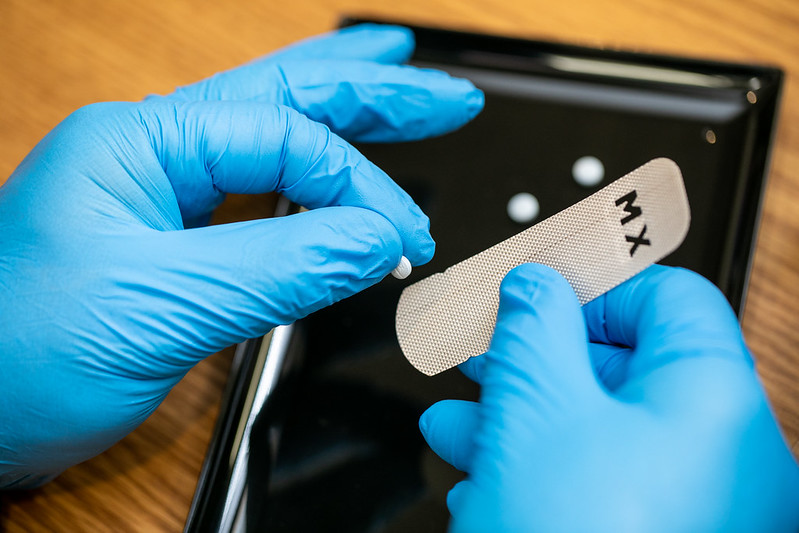
This allows responders to:
- Confirm whether the substance is fentanyl, carfentanil, or another analog.
- Determine if mixtures (e.g., fentanyl-laced cocaine, xylazine, or nitazenes) are present.
- Guide safety and decontamination protocols for the responding team.
This immediate confirmation enables safer evidence handling and ensures accurate reporting in toxicology investigations.
Integrating MX908 Results into Case Development
Once the scene is secured, the MX908 provides real-time data that supports the evidentiary chain for downstream prosecution. For instance, in one specific case in the southwestern United States, a team investigated the overdose death of a local high school student. Rapid field analysis helped confirm the presence of fentanyl-laced M30 pills, later corroborated by lab testing and toxicology reports.
By identifying the substance early at the scene of the death, investigators could immediately link the overdose to a known distribution network, accelerating the issuance of search warrants, subpoenas, and subsequent arrest. This speed of evidence acquisition often determines whether dealers can be charged federally for distribution resulting in death.
One officer noted “We sometimes test right at the scene with our 908 machine to determine what we have. That information is critical for building probable cause and keeping the investigation moving quickly.”
Enhancing Officer Safety and Operational Efficiency
The MX908’s trace-level sensitivity (nanogram level) allows teams to detect fentanyl and related analogs even when quantities are invisible to the naked eye.
For example:
- Residue detection: Fentanyl trapped in straws, dollar bills, or phone cases.
- Environmental monitoring: Airborne or surface contamination checks before entering spaces.
- Cross-contamination prevention: Rapid verification of unknown powders prevents unnecessary exposure or panic.
Conclusion
Turning Data into Action
The fentanyl epidemic represents one of the most complex public health and criminal justice challenges in modern history. Addressing it requires speed, interagency coordination, and precise field identification tools. The MX908 provides law enforcement with the ability to:
- Rapidly identify trace amounts of fentanyl, fentanyl analogs, and other drugs at overdose scenes.
- Protect officers and civilians from accidental exposure.
- Preserve and strengthen evidentiary chains for prosecution.
- Support real-time decision-making in high-risk environments.
Integrating the MX908 into overdose investigations not only enhances safety and efficiency but also turns tragedy into actionable intelligence, helping dismantle the supply chains fueling this crisis.
Reference:
- Provisional Drug Overdose Death Counts. https://www.cdc.gov/nchs/nvss/vsrr/drug-overdose-data.htm. Ahmad FB, Cisewski JA, Rossen LM, Sutton P. National Center for Health Statistics. 2025.
Subscribe to Our Communications
Signup to receive new product updates, technical tips and more.